Dunsfold Aerodrome
Cloaked in secrecy, Dunsfold Aerodrome was screened from public gaze by woodland and much of its work was protected by the Official Secrets Act until the early 1990s. The full story of the Aerodrome was a mystery for over 50 years and only became public knowledge when its records were de-classified and a compilation was made of stories from those who served and worked on the Aerodrome.
In 1942, an aerial survey of the rolling Surrey Hills revealed an area of level tree tops which suggested flat ground below. Located near to the existing 1st Canadian Army, the area comprised of pasture and woodland and was described by Wing Commander McIntyre of the Royal Canadian Army as “fairly level”. The flat land was acknowledged for its suitability as an airfield.
Situated just a few miles from Guildford and Godalming, the airfield began its life on 11 May 1942 when the First Canadian Army – mainly the 2nd Battalion Royal Canadian Engineers - began construction of the emergency airfield. On 2nd July 1942, Clement Atlee and Deputy Prime Minister Colonel Archibald took a tour of the construction site.
On 15th August 1942, the construction of the runways was completed. Under the summer sun, the concrete surface was bleached white and could be seen for miles in the air. In an effort to camouflage the concrete a mixture of tar and wood chippings was sprayed onto the surface. A favourite trick of pilots was to fly low along the length of the runway and where the wood chippings had not adhered to the tar they would blast an impressive cloud of chippings into the air with their propeller wash.
After just 20 weeks on 16 October 1942, the site was officially handed over to the Royal Canadian Air Force.
Dunsfold Aerodrome played an important and continuous role in World War II, including in the defence of the country and in connection with the Allied invasion and liberation of occupied Europe during and following D-Day.
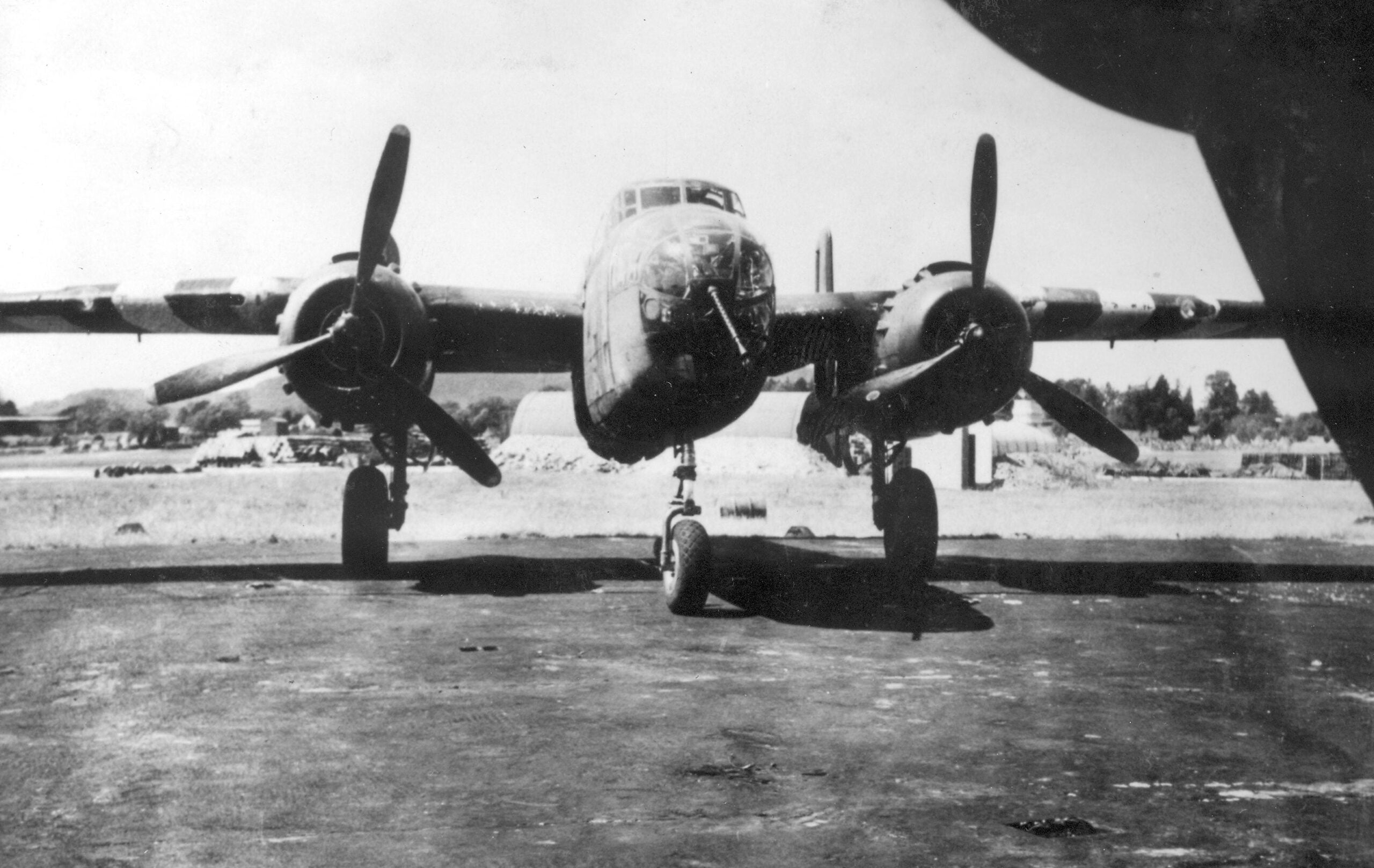
During the Second World War, the Aerodrome was a base for large numbers of aircraft including Mitchell Bombers, Typhoons, Mustangs, Mosquitoes and Spitfires. It was also used by a large number of military personnel including those from the Royal Canadian Air Force, the RAF, the Royal Australian Air Force, the Royal New Zealand Air Force and the Royal Dutch Naval Air Service.
On 18th April 1944 Dunsfold was visited by the Supreme Commander General Dwight Eisenhower who conducted an inspection of the aircraft and crews of 98 and 320 Squadrons before addressing all personnel in one of the hangars (now known as Hangar 57) stressing the urgent need to train and be prepared for the challenges ahead. He said, “We will expect nothing less than full victory.”
Dunsfold’s major Second World War achievements include its participation in D-Day. The arrival of Operations Order Number 3 on 3rd June 1944 outlined the 2nd Tactical Air Force’s plans for Dunsfold’s Mitchells. Upon receipt of this order, only one question remained regarding D-Day for Dunsfold’s squadrons – when? A further priority order on the evening of the 5th June led to the RAF Regiment suddenly sealing off the camp. All non-service letters, telephone calls and telegrams were halted while ground crews worked feverishly to apply black and white invasion stripes to the wings and fuselage of each Mitchell.
As midnight approached the crews were briefed on their respective targets. Unaware of the extent of the mission the squadrons completed their orders with varying success at attacking their targets due to the poor weather conditions. It wasn’t until dawn broke on the return journey to Dunsfold that the crews were aware that an invasion was fully underway as a gap in the cloud revealed the sea was black with ships and the sky full of aircraft. Despite being unaware of the extent of the invasion, which is known as the largest amphibious invasion in world history executed by land, sea and air, their involvement in the Normandy landings earned them the title ‘Heroes of the Night’.
After the war, the airfield was used as a repatriation centre and over 47,000 prisoners of war were returned to their homelands using Dakota, Lancaster, Stirling and Halifax aircraft. The RAF aircraft continued to be based at the Aerodrome until May 1946 and on 9th August 1946, the RAF was instructed to make many of the facilities at the Aerodrome available until further notice to the Ministry of Civil Aviation for use by Skyways Limited.
Did you know?
During the early Second World War period, the Aerodrome was used for the practice of deck landings by visiting Spitfires. This was almost certainly one of the trials of Prime Minister Churchill’s idea of ‘floating aerodromes’ to be anchored just off invasion beaches.